AI Can't Predict Price. Here Is What It Can Do.
By CryptoTraders · Market Education · 2026-06-27
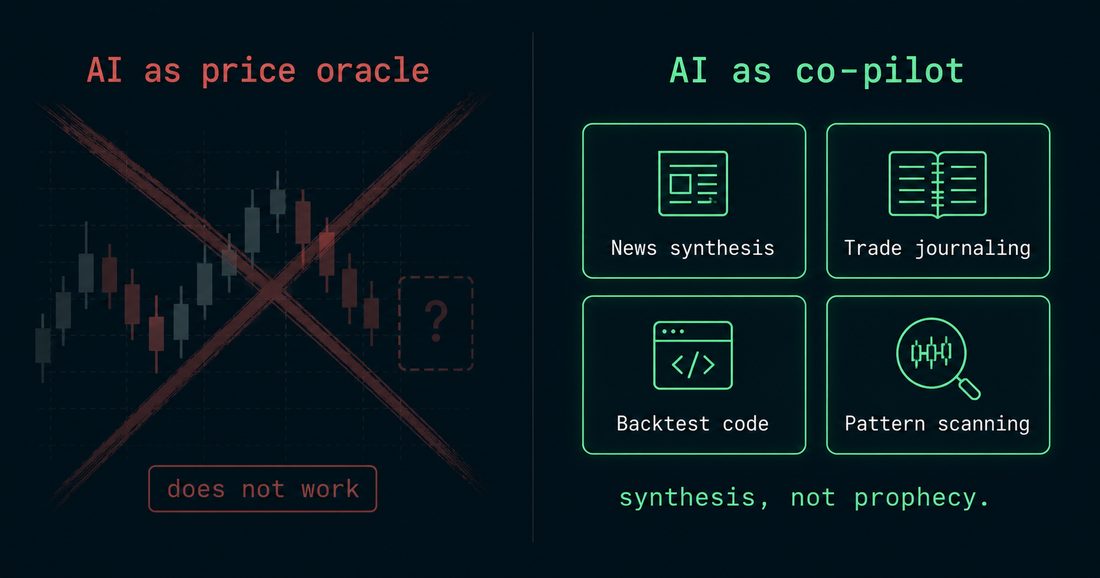
For two years the loudest story in crypto was the autonomous AI trading agent: drop in a language model, let it trade, watch it print. The token prices that rode that story have mostly collapsed, and the research that followed is blunt about why. AI is genuinely useful to a trader. Predicting price is not the thing it is useful for.
What the evidence actually shows
A 2026 study of nearly 2,000 AI-tagged crypto projects found that of ten prominent trading agents, only three actually executed trades on their own. The rest gave advice, ran simulations, or quietly needed a human to approve everything. Users of these agents lost a combined figure in the hundreds of millions while the projects' own tokens fell around 90% from their highs. The team behind one of the largest agent frameworks put it plainly: language models cannot trade well without human insight.
There is a deeper reason the backtests look better than the live results. When a language model appears to predict a market, it is often recalling patterns from its training data rather than reasoning about the future, a contamination called lookahead bias. The impressive historical accuracy is partly memorization, and it does not survive contact with data the model has never seen. An AI that aces the past and fails the present is not predicting. It is remembering.
What AI is actually good at
Point the same tools at the right problems and they earn their keep. Language models are strong at synthesis and language: summarizing a wall of news into what matters, triaging sentiment, drafting and checking backtest code, structuring a trade journal, scanning for patterns across more charts than a human can watch. That is decision support, not autonomous alpha, and it is genuinely valuable. The mistake is asking a synthesis tool to be an oracle.
How we use it
Our algos use AI the way the evidence supports, not the way the hype sold it. The edge is systematic: statistically defined triggers, multi-factor confluence, and risk management, the parts that actually hold up out of sample. AI does the job it is good at, generating clear, readable reasoning attached to each signal so you can see why a trade qualified rather than staring at a black box. The decision logic is rules. The explanation is AI. We do not ask a language model to predict the next candle, because the research is clear that it cannot, and neither can anyone selling you one that claims to.