Tax-Loss Harvesting for US Crypto Traders: The 2026 Checklist.
By CryptoTraders · Strategy · 2026-10-23
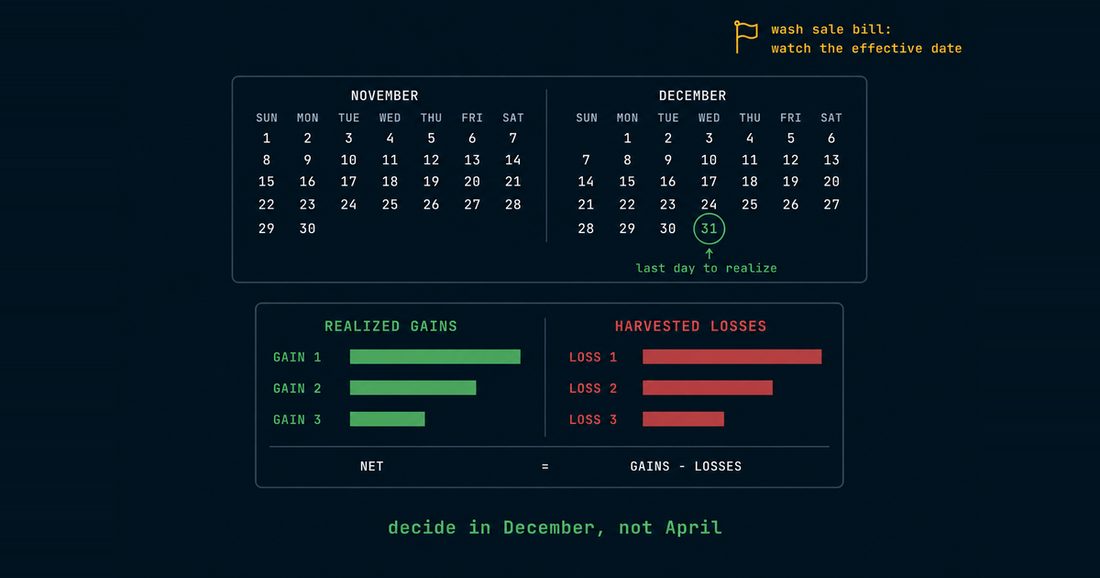
Every December, US traders discover that a bad year comes with one consolation. Realized losses offset realized gains, and up to $3,000 of net capital loss a year can offset ordinary income, with the remainder carried forward to future years. The catch is the word realized. A position that is down 60% but still open does nothing for your tax bill. Harvesting means closing it before December 31 to lock the loss in.
Why crypto has been different from stocks
With stocks, the wash sale rule disallows a loss if you buy the same or a substantially identical security within 30 days before or after the sale. The IRS treats crypto as property, and the wash sale rule in Section 1091 is written for stock and securities, so the prevailing reading has been that a trader can sell a coin at a loss and buy it back the same day while keeping the loss. Crypto tax software has built whole features around that gap.
What changed in 2026
Two things. The first is reporting. Centralized US exchanges now issue Form 1099-DA, starting with gross proceeds for the 2025 tax year, and cost basis reporting covers assets acquired on or after January 1, 2026 and held at the same broker. The IRS now sees your sales whether you report them or not, and transfers between platforms are where basis gaps appear. Reconcile before you file.
The second is legislation. In September 2026 the House Ways and Means Committee approved the Digital Asset Tax Certainty Act, which would extend wash sale rules to digital assets. As amended in committee, it would apply to sales after September 14, 2026. It is not law as of this writing, and Senate proposals differ on timing. The effective date is the detail to watch: if a version with that date is enacted, a same-day sell and rebuy done this fall could see its loss disallowed after the fact.
Where derivatives fit
Trading Journal: Log every trade in R, tag and grade your setups, and get AI reviews that point at your actual leaks. See the Trading Journal
Regulated Bitcoin and Ether futures on US exchanges such as CME are generally Section 1256 contracts, marked to market at year end and taxed 60% long-term and 40% short-term regardless of how long you held them. Perpetual swaps on offshore or on-chain venues generally do not get that treatment, and most practitioners report them under ordinary property rules, with each close a taxable event. Funding payments add another line item. If you traded perps this year, your realized result is spread across hundreds or thousands of fills, and an export from each venue now beats a scramble in April.
A checklist before December 31
Export the full trade history from every exchange and wallet you used this year, including any you have since abandoned. Work out your net realized gain or loss for the year to date, separately from what is still open. List the open positions sitting at a loss and decide, on their merits, whether you still want them. If you harvest a loss and want to keep the exposure, check where the wash sale bill stands first, or wait more than 30 days before buying back, or rotate into a different asset, which removes the question entirely. Then book time with a tax professional who works with crypto while there is still time to act on their advice.
Nothing here is tax advice, and both the rules and the bill can move before year end. The practical point is simple. The trades you close in the next few weeks carry a tax consequence, and a decision made in December beats a surprise in April.
Educational content, not financial advice. Trading leveraged products carries a high risk of loss.