Leverage Doesn't Decide Your Risk. Your Stop Does.
By CryptoTraders · Strategy · 2026-05-31
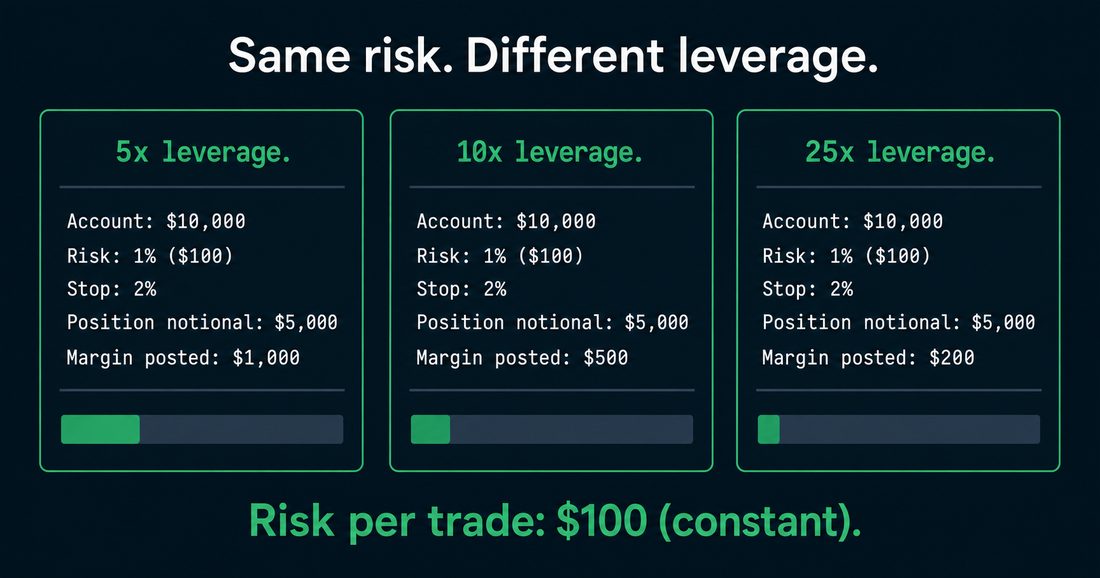
Crank up to 50x and you feel like you are taking more risk. You are not. You are using less of your margin to hold the same position. The risk per trade is set entirely by your stop distance and your position size, and leverage is the lever for one of those two things. If you do not size for the stop, leverage just tells you how fast the failure happens.
What actually determines risk per trade
Risk per trade is the dollar amount you stand to lose if your stop is hit. The math: Risk $ = Position Size x Stop Distance. That is it. Leverage does not appear in this equation. Leverage only sets how much margin you must post to open a given position size, which controls whether you can put on the trade, not how much you will lose if it goes wrong.
This trips up almost every new perp trader. 'I traded at 20x' tells you nothing about the risk taken. A 20x trade with a tight stop and small size risks less than a 5x trade with a wide stop and large size. The leverage number is downstream of the sizing decision, not the cause of it.
Fixed-fractional sizing
The cleanest sizing method, and the one most professionals teach first, is fixed fractional: risk a fixed percentage of your account on every trade. Position Notional = (Account x Risk%) / Stop %.
Example. $10,000 account, 1% risk per trade ($100 risk), a setup with a 2% stop. Position notional = $100 / 0.02 = $5,000. At 10x leverage, that requires $500 of posted margin. At 5x, $1,000. The risk is $100 either way.
This is the floor every other method builds on. Two percent risk per trade is the conventional cap. For high-leverage perps specifically, where liquidation cascades and funding spikes add tail risk that 2% does not price in, dropping to 0.5 to 1% above 5x leverage is the widely recommended adjustment.
Volatility-scaled (ATR) sizing
The improvement on fixed-fractional is to let each coin's own volatility set the stop, rather than imposing the same percentage stop across radically different assets. Position Size = (Account x Risk%) / (ATR x Multiplier).
ATR (Average True Range) over the last 14 candles on your entry timeframe is the standard input. Common multipliers: 1.5x for aggressive scalping (tight, gets stopped often), 2.0 to 2.5x for intraday and short swings (the conventional sweet spot), and 3.0x or wider for swing and position trades designed to survive normal pullbacks.
The advantage is that a volatile altcoin gets a wider stop and a smaller position. A quiet major gets a tighter stop and a larger position. Risk in dollars stays constant across trades. R-multiples stay comparable.
Kelly, and why fractional
Full Kelly sizing optimises long-run growth rate if your win rate and payoff are known exactly. They never are. Retail edge estimates carry wide error bars, and Kelly is hyper-sensitive to those errors. Overshoot by a little and you compound to ruin faster than the math suggests.
Quarter-Kelly (25%) or Half-Kelly (50%) is the professional standard. Half-Kelly cuts equity-curve volatility by roughly 25% while sacrificing only around 25% of the long-run growth rate. The asymmetry is worth it, and on leveraged perps where a single funding spike can magnify a tail event, the case is stronger.
Common pitfalls
Three recurring mistakes: First, treating leverage as a risk setting. It is not. Size for the stop, then choose the leverage that gives you the margin requirement you want.
Second, position-sizing in percentage of account, then forgetting the percentage when the account doubles. Two percent of $20,000 is twice the dollar risk of 2% of $10,000. That is the correct behaviour. The issue is when traders stop verifying the dollar number.
Third, sizing without accounting for the maintenance margin tier. Bybit's Risk Limit system lowers your maximum leverage as position notional grows. A position you opened at 25x may have its maintenance margin requirement quietly increase as it scales, eroding your effective stop distance.
How CryptoTraders handles this
The Copy Trading Bot does the position-sizing automatically for every member who has it on. Each signal is sized to a fixed dollar-risk per trade on the member's account, not a fixed contract size, so a $5,000 account and a $50,000 account take the same trade at proportionally correct size. Auto break-even on TP1 protects the trade once it is running. A global max loss limit caps the day if a string of stops gets hit. Selective copy via emoji reactions lets members opt in to individual signals if they want to be selective.
This is the gap between 'the algo posts' and 'the algo trades for you at the correct size.' It runs on Elite Plus, on Blofin (no KYC).