The CME Gap Lost Its Weekend.
By CryptoTraders · Market Education · 2026-10-26
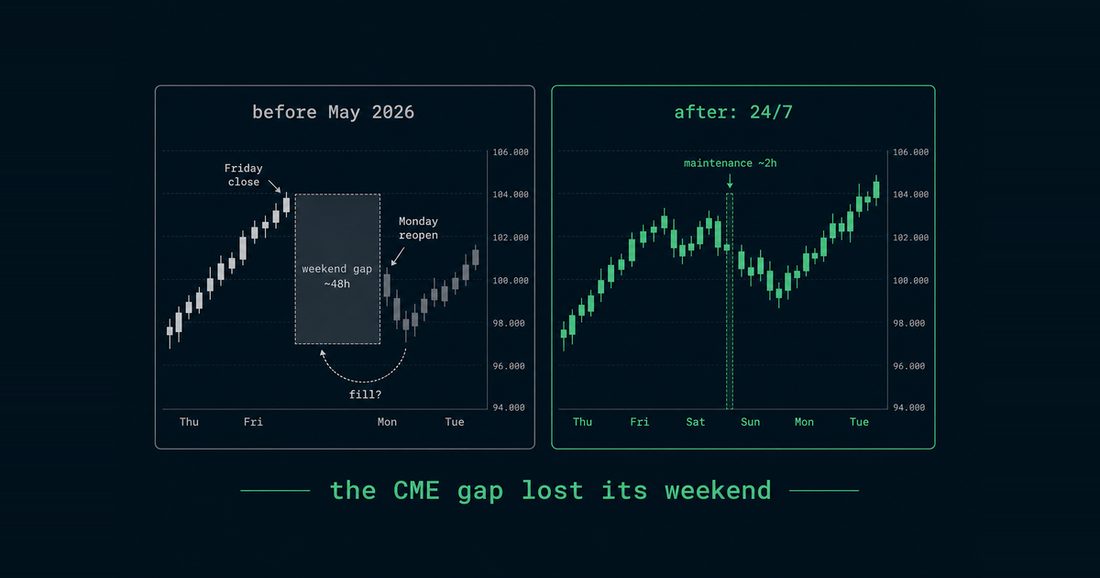
For most of Bitcoin's futures history, one chart pattern did the rounds every Monday: the CME gap. CME's Bitcoin futures closed on Friday afternoon and reopened on Sunday evening, US Central time, while spot Bitcoin kept trading through the weekend. If spot moved in the meantime, the CME chart reopened at a different price and left an empty space behind. A popular belief held that price would come back to fill it.
Why gaps used to fill
There was some logic beneath the folklore. A weekend move happened on thin liquidity, with most institutional desks offline, so it was more prone to retracing once full participation returned on Monday. Basis traders running CME positions against spot also had reasons to push the two prices back into line. Trading education sites quoted fill rates anywhere from about 70% to over 90%, though those figures depend heavily on how long you allow for the fill, and some gaps sat open for months.
What changed on May 29, 2026
CME moved its crypto futures and options to round-the-clock trading at the end of May 2026, after announcing the plan in February. The weekend closure is gone, replaced by a short weekly maintenance window of about two hours. With CME trading the weekend alongside spot, the roughly 48-hour gap behind most of the famous examples no longer forms. A small gap can still appear across the maintenance window, but it spans two hours of price movement where the old ones spanned two days.
What is left of the rule
Gaps created before the switch remain on the chart, and some traders still mark them as levels. That can work for the reason any widely watched level works: if enough people rest orders there, the level becomes real. The mechanism that made a fresh gap likely to retrace, a dislocation built on thin weekend liquidity, has mostly been removed for new price action.
There is a broader lesson here. Many crypto trading rules are byproducts of market plumbing: session opens, funding times, weekend liquidity, exchange hours. When the plumbing changes, the rule changes with it, often before the people repeating it notice. Before you trade a pattern, ask what mechanism it depends on and check that the mechanism still exists. If it is gone, you are trading a memory.
Weekend liquidity is still thinner than weekday liquidity, and that part has not changed. A breakout on a Saturday still deserves more skepticism than the same breakout on a Tuesday. You just cannot measure the weekend with a gap on the CME chart anymore.
Educational content, not financial advice. Trading leveraged products carries a high risk of loss.