CPI, Jobs, the Fed: How Crypto Trades Macro Days.
By CryptoTraders · Market Education · 2026-10-20
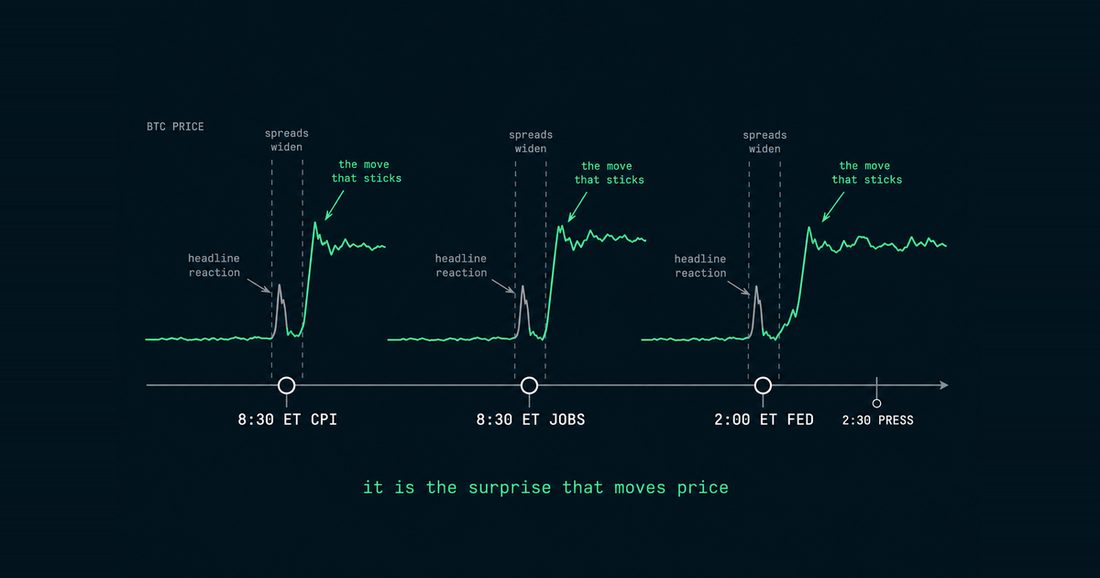
Most crypto volatility arrives without warning. Some of the biggest moves of any month arrive with a calendar invite. The US consumer price index, the monthly jobs report and the Federal Reserve's rate decisions land at known times, and Bitcoin now trades them like a macro asset, because the money that sets its marginal price, ETF allocators and basis desks among it, watches the same screens as the bond market.
The three releases that matter
CPI prints at 8:30 a.m. Eastern, usually in the second week of the month. It moves crypto through one channel: what it implies for the path of interest rates. A hot core reading pushes rate expectations up and tends to pull Bitcoin down with the Nasdaq, and a soft one does the reverse. The headline figure gets the first reaction. Core, which strips out food and energy, gets the second, and the second reaction is usually the one that sticks.
The jobs report also lands at 8:30 a.m. Eastern, normally on the first Friday of the month. Payrolls, the unemployment rate and wage growth can point in different directions inside one release, which is why the first candle after a jobs print is so often reversed within the hour.
The Fed's decision comes out at 2:00 p.m. Eastern on the second day of each FOMC meeting, with the chair's press conference 30 minutes later. There are eight meetings a year, and four of them come with fresh economic projections and the dot plot. The statement moves price first. The press conference regularly moves it again, sometimes the other way.
It is the surprise that moves price
A 3% inflation print can rally Bitcoin if the market expected 3.3%. What matters is the gap between the actual figure and the consensus forecast, and, more subtly, the gap between the forecast and what traders were positioned for. That is why the same release can produce a violent spike one month and a shrug the next. Before a release, check three things: the consensus, the previous reading and whether it might be revised, and how crowded positioning is. Funding running hot into a CPI print means a hot number has a lot of longs to liquidate.
A playbook for the hour around the print
Shrink or close anything with a tight stop before the release. Spreads widen and order books thin in the minutes before 8:30, and a stop sitting a fraction of a percent away can fill far worse than its level. If you hold through, size the position so that a 3% move against you is survivable, because on a genuine surprise it is possible.
Let the first five minutes go. The opening spike is algorithms reading the headline. The move over the next 30 to 60 minutes, once the core figures and revisions are digested, is the one carrying information. Many experienced traders wait for the first 15-minute candle to close and treat its high and low as the range to break.
On Fed days, treat 2:00 and 2:30 as two separate events, and assume the statement reaction may not survive the press conference. Then mark the calendar ahead: the October 27 to 28 meeting and the December 8 to 9 meeting, which carries new projections, are the two largest scheduled risk events left in 2026.
None of this predicts direction. It keeps you out of the fills that hurt most and points your attention at the part of the move that tends to mean something. Our macro calendar posts a reminder six hours and one hour before every major release, then the actual against the forecast the moment it prints.
Educational content, not financial advice. Trading leveraged products carries a high risk of loss.