Read the Drawdown Rule Before You Buy a Crypto Prop Challenge.
By CryptoTraders · Strategy · 2026-11-16
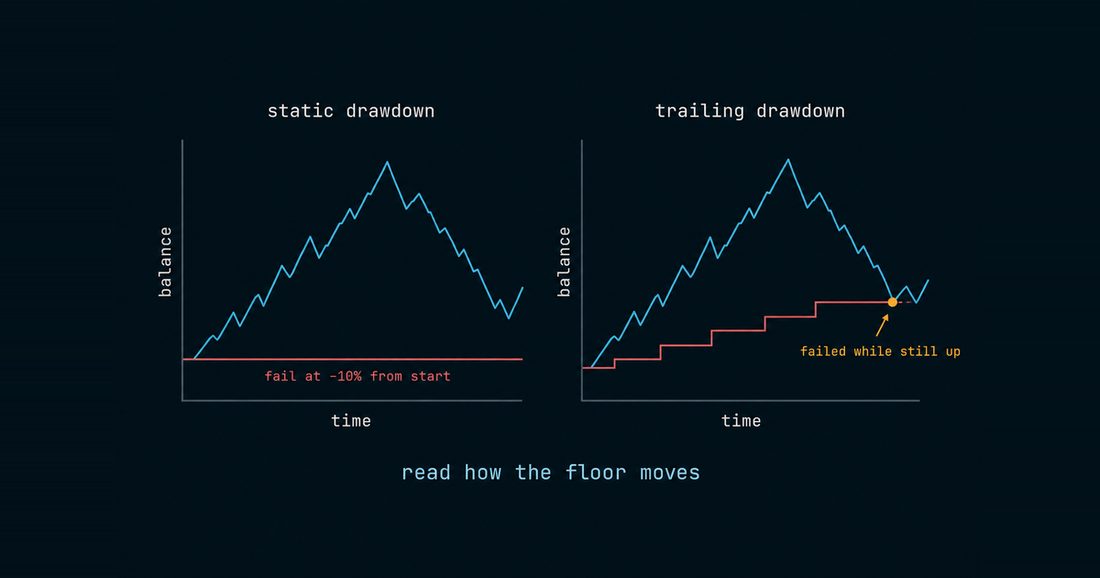
Crypto prop firms sell a simple offer. Pay a fee, trade an evaluation account to a profit target without breaking the risk rules, and earn a share of the profits on a funded account. At reputable firms the offer is real. It is also a business in which much of the revenue comes from traders who fail, so the rules deserve the same scrutiny you would give a trade.
The rule that decides most challenges
Every challenge has a maximum drawdown, and how it is measured matters more than its size. A static drawdown is measured from your starting balance: on a $100,000 account with a 10% limit, you fail at $90,000 and nowhere else. A trailing drawdown follows your highest balance, or worse, your highest unrealized equity. Make $6,000 and the floor rises to $96,000, so a winning trade that reverses can fail you while the account is still up overall. Daily loss limits add a second floor that resets each day, often measured from the day's starting equity including open positions.
A trailing limit on intraday equity punishes the exact behavior good trading needs, letting winners run. Read the definition word by word, and if the terms say equity, assume open profit counts against you.
The rest of the fine print
Check the restrictions on holding positions over the weekend or through news, minimum trading days, consistency rules that cap how much of your profit can come from one day, and the maximum leverage per asset. Check what you are actually trading: most evaluations run on simulated accounts, funded accounts are often simulated too, and payouts come from the firm's own revenue. Check how payouts work, how often, with what minimum, and whether the firm reserves discretion to review or deny them. Then search for how the firm has handled disputes. Payout denials over rule interpretations are among the most common complaints across the industry.
For perp-based challenges, add one more line to the list: funding. A position held across several funding windows during a volatile week pays a cost that can eat into a tight daily limit without any visible move against you.
Should you take one?
A challenge is a reasonable bet for a trader who already has a record of consistent results, risk per trade around 0.5% to 1%, and a strategy that does not rely on holding through high-impact events. It is a poor first step for anyone still learning, because the fee turns into a recurring cost of practice. Trade a small account of your own, or a demo, under the challenge's exact rules first. If you cannot pass on paper under those constraints, paying the fee will not change the outcome.
Educational content, not financial advice. Trading leveraged products carries a high risk of loss.