After the Sweep: Reading the Reclaim.
By CryptoTraders · Strategy · 2026-11-04
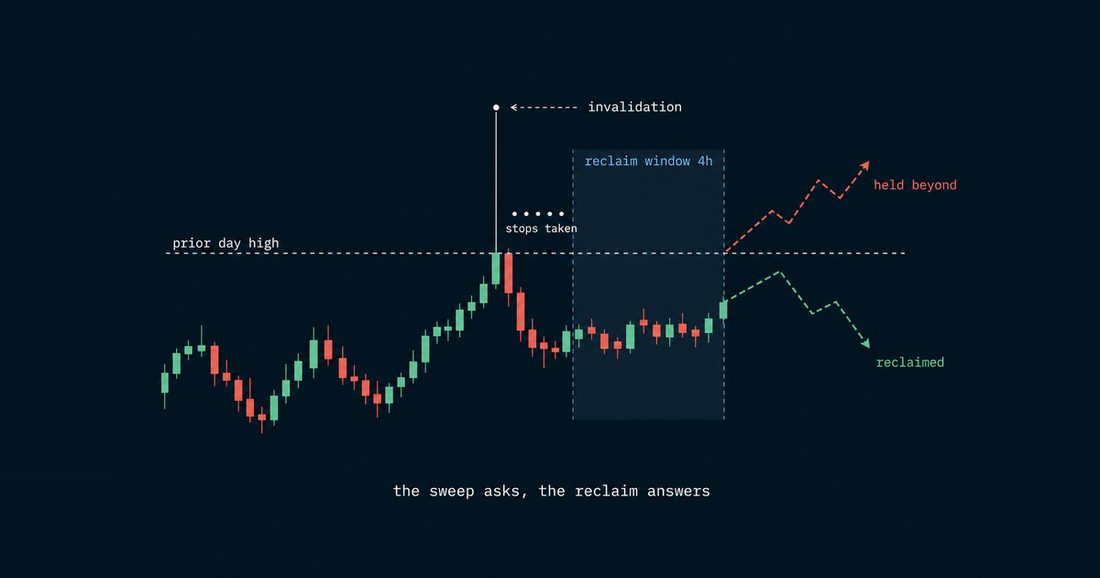
We have written before about why stops get wicked: obvious levels collect obvious stops, and price is drawn to the liquidity resting there. That post was about defense. This one covers what happens next, because the hours after a sweep hold some of the most useful information on the chart.
A sweep, then one of two outcomes
A sweep is a push through a well-watched level, such as the prior day's high, a weekly low or a range boundary, that triggers the stops and breakout orders resting beyond it. Then one of two things happens. Price closes back inside the level and holds there, which is a reclaim. Or it keeps going and the level breaks for real. A reclaim suggests the move beyond the level was mostly stop-running with little fresh conviction behind it. A clean break says genuine supply or demand was waiting on the other side.
How long to wait
The time you allow for a reclaim should scale with the level. A sweep of the prior day's high deserves a few hours to show its hand. A sweep of a weekly or monthly level can take a day or two to resolve. Our Liquidity Sweeps tracker uses windows built this way, from four hours for a daily level up to 48 hours for a monthly one, and records each sweep as reclaimed or held beyond once its window closes.
Location first, confirmation second
The common mistake is to treat a reclaim as an entry by itself. In isolation, a reclaim is close to a coin flip: plenty of them fail and price goes back through the level. What a reclaim does give you is a location with a clearly defined invalidation, the sweep extreme. That makes it a good place to look for a setup you already trade, such as a change of character on a lower timeframe, a divergence or a shift in open interest, and a poor place to trade blind.
Two more filters help. Higher-timeframe context: a reclaimed sweep of a daily low inside a weekly uptrend lines up with the bigger picture, while the same reclaim inside a weekly downtrend is fighting it. And what open interest did during the sweep: if open interest dropped sharply as price ran the level, positions were forced out, which is the cleanest version of a stop run. If open interest rose, new positions were opening into the break, and the break deserves more respect.
Think of every sweep as a question the market is asking. The reclaim window is how long you give it to answer, and the answer is context for your next decision. Traders who wait for the answer, and then for their own setup, take fewer of these trades and keep more of what they make on them.
Educational content, not financial advice. Trading leveraged products carries a high risk of loss.