The Trade After the Loss.
By CryptoTraders · Strategy · 2026-10-29
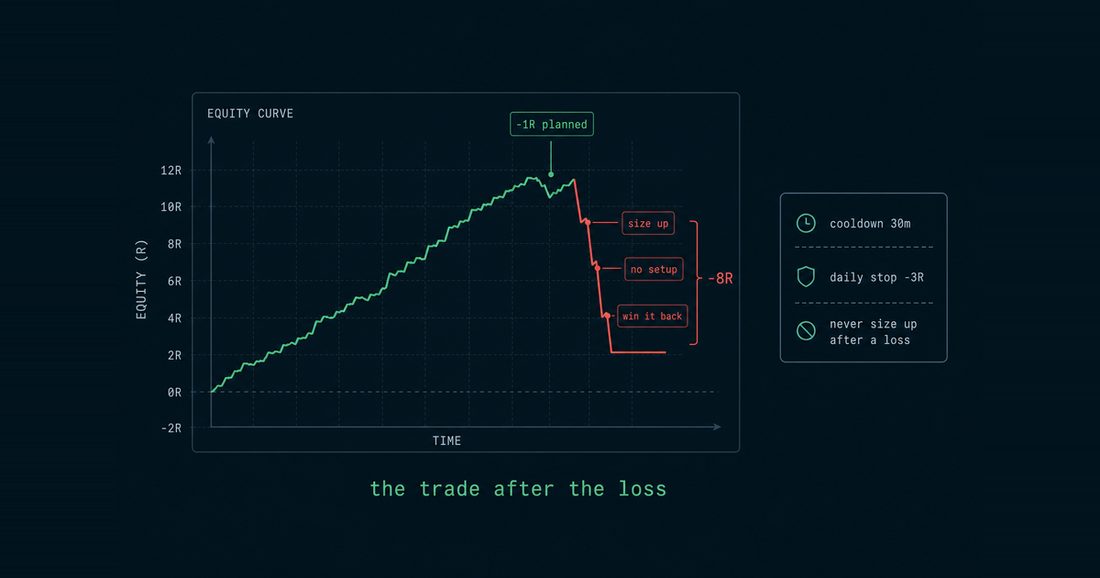
Look back through the worst weeks in any trader's record and the same shape keeps appearing. A planned loss, normal and survivable. Then, within the hour, a second entry with no real setup behind it and a larger size, meant to win the money back. Then a third. The first loss cost 1R. The sequence cost eight.
Why the brain does this
Loss aversion is one of the best-documented findings in behavioral economics: a loss hurts roughly twice as much as an equal gain feels good. After a loss, the goal quietly shifts from executing your process to getting back to even, and getting back to even is a goal the market has no reason to help you reach. Leverage makes it worse. On a perp account, winning it all back in one trade is always one button away, which is why the same impulse does far more damage on futures than in a spot account.
Finding it in your own data
Revenge trades leave fingerprints. Pull your last 100 trades and mark every entry opened within 30 minutes of a losing exit. Compare that group with the rest on three things: size relative to your normal size, whether the setup matches anything you trade on purpose, and the result in R. For most traders who do this honestly, the post-loss group is larger, less planned and clearly worse. That comparison will do more for you than any amount of reading about discipline, because it is your money and your pattern.
Rules that hold under pressure
Willpower fails at exactly the moment you need it, so the useful rules are mechanical. A cooldown: after any loss larger than 1R, no new entry for a fixed period, say 30 minutes or the next candle close on your trading timeframe, whichever comes later. A daily loss limit: at minus 3R on the day, you are done until tomorrow, whatever the chart looks like. A size ceiling: the trade after a loss is never larger than your standard size, and some traders deliberately make it smaller.
Write these rules down before the session, when the calm version of you is making the decisions. Then make breaking them visible. A journal tag for post-loss entries turns an invisible habit into a number you have to look at every week, and numbers you look at every week tend to improve.
A loss is information about one trade. The urge to win it back is information about you, and it is the more expensive of the two to ignore. The market will hand you another setup tomorrow. The only trade that has to happen today is the one already in your plan.
Educational content, not financial advice. Trading leveraged products carries a high risk of loss.