Auto-Deleveraging Explained: When Your Winning Trade Gets Closed
By CryptoTraders · Market Education · 2026-11-25
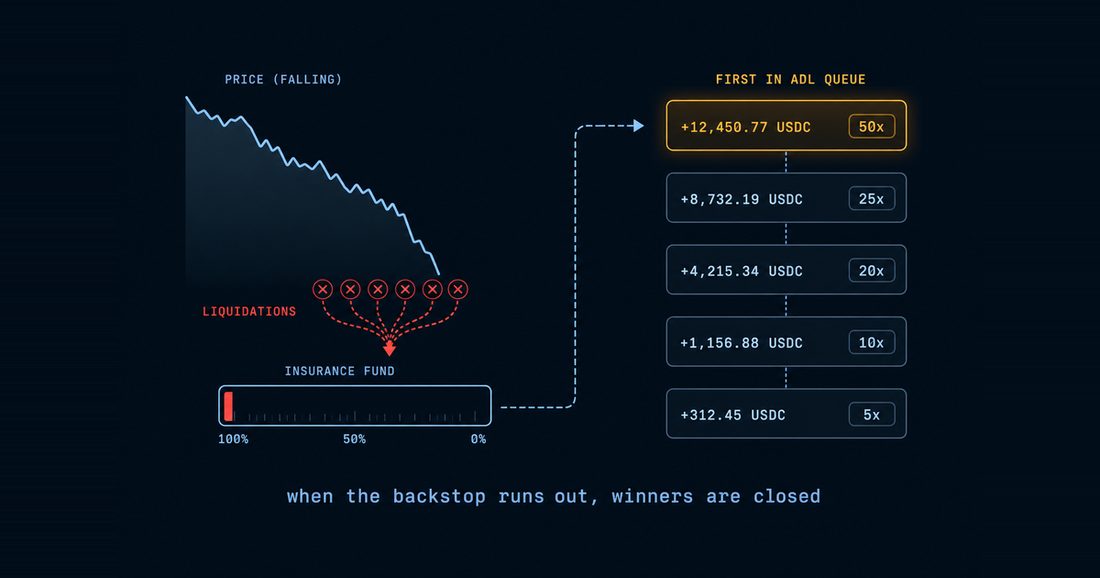
Most traders know how a liquidation works: the position loses too much, margin runs out, and the exchange closes it. Fewer know that a winning position can be closed too. That is auto-deleveraging, or ADL, and it is the last line of defence an exchange uses when losses grow faster than it can absorb them.
Why ADL exists
Every perpetual futures market has two sides. When a losing trader is liquidated, the exchange needs someone to take the other side at a price that still covers the loss. In normal markets the order book and an insurance fund (or, on Hyperliquid, its HLP vault) handle this. In a fast crash, liquidations can arrive faster than the book can fill them, and the backstop runs short. At that point the exchange closes part of the opposite side, the traders who are in profit, at the bankruptcy price of the liquidated accounts. The market stays solvent, and the winners pay for it.
What October 10 2025 showed
On October 10 2025 a tariff headline set off the largest liquidation day in crypto history. On Hyperliquid, the cross-margin ADL triggered for the first time in more than two years, in a window of about ten minutes during the evening in UTC. Several centralized exchanges also ran ADL on some pairs. Studies of the day disagree on the exact figures, but the lesson is the same: traders with well-placed shorts saw part of their profit closed early, often at prices far from where the market later settled.
Who gets closed first
Exchanges rank profitable positions for ADL by a mix of profit and effective leverage. The trader with the biggest unrealized gain on the highest leverage sits at the front of the queue. Most venues show this as a small indicator next to the position, often five bars or lights. If yours is full during a violent move, you are among the first in line.
How to lower your exposure
Lower leverage on a winning position moves you back in the queue. Taking partial profit into a cascade does the same and locks in gains the exchange could otherwise close for you. Avoid stacking your whole book on one venue during known event risk. And check whether your exchange discloses its insurance fund size: a large, visible fund means ADL is less likely to reach you.
ADL is rare. It is also the one risk in perps you cannot stop with a stop loss, which makes it worth understanding before the day it happens.
Educational content, not financial advice. Trading leveraged products carries a high risk of loss.