Break of Structure or Change of Character?
By CryptoTraders · Market Education · 2026-11-01
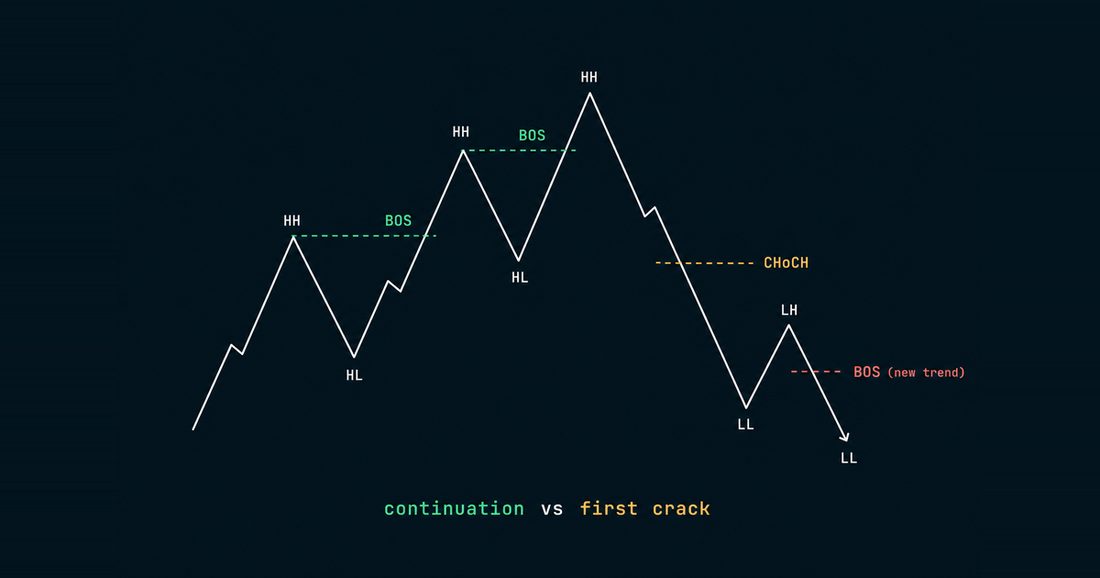
Open any chart drawn in the smart money style and two abbreviations are scattered across it: BOS and CHoCH. Both describe the same physical event, price breaking a prior swing point, and they mean nearly opposite things. Mixing them up is how traders end up shorting the first pullback in an uptrend or buying the top of a range.
Start with the swings
Market structure is the sequence of swing highs and swing lows. An uptrend prints higher highs and higher lows. A downtrend prints lower lows and lower highs. Everything else depends on marking these points consistently, so choose a definition and stick to it, for example a swing high is a candle with two lower highs on each side, on the timeframe you actually trade.
Break of structure: the trend continues
A break of structure, or BOS, is a break in the direction of the existing trend. In an uptrend, price closes above the most recent swing high. It confirms the trend is intact, and for a trend trader it marks the moment the latest higher low becomes the reference for stops and re-entries. BOS events are the normal heartbeat of a trend, which is why they are frequent and, on their own, unremarkable.
Change of character: the first crack
A change of character, or CHoCH, is the first break against the trend. In an uptrend, it is a close below the most recent higher low, the swing that the last break of structure was built on. It tells you the sequence of higher lows has failed. It does not yet confirm a downtrend, which needs a lower high and a further break lower. Treat a CHoCH as the point to stop adding in the old direction and start watching for evidence of the new one.
Where traders go wrong
Three mistakes account for most of the confusion. Wick breaks: a wick through a swing point that closes back inside is more often a liquidity sweep than a structural break, so require a candle close beyond the level. Timeframe mixing: a CHoCH on the 5-minute chart inside a strong 4-hour uptrend is usually a pullback, so label each timeframe separately and let the higher one set your bias. Internal and external swings: minor swings inside a larger leg break constantly, and the swings that bound the whole leg are the ones that define the trend.
Used together, the two labels give you a simple sequence. Trade with the trend while breaks of structure keep printing. Go flat or defensive on the first change of character. Wait for the new direction to confirm with a break of structure of its own before committing to it.
Educational content, not financial advice. Trading leveraged products carries a high risk of loss.