Fair Value Gaps: Which Ones Deserve Your Attention.
By CryptoTraders · Market Education · 2026-11-19
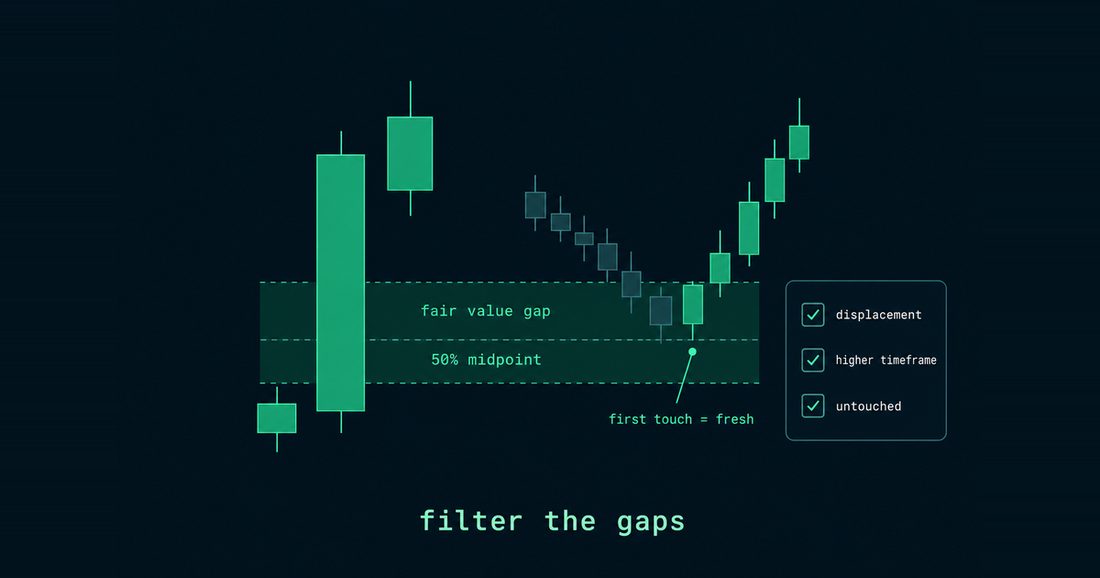
A fair value gap is the most visible footprint a fast move leaves on a chart. In a three-candle sequence during a sharp rally, if the first candle's high sits below the third candle's low, the space between them was traded through in one direction with almost no overlap. Smart money concepts call that space an imbalance and expect price to return to it. Mark every gap on a 15-minute chart and you will have dozens a day, which is exactly the problem.
Why price revisits imbalances
The reasoning is about order flow. A move that fast filled orders on one side of the book only. Resting orders that would normally have traded inside that range were skipped, and a return into the gap lets the market trade both sides where it previously traded one. Sometimes the gap fills completely. Often price reaches the gap's midpoint, sometimes called consequent encroachment, and turns from there.
Three filters
Displacement. The gap should come from a candle clearly larger than its neighbors, ideally one that also produced a break of structure. A gap created by a move that changed the market's direction carries information. A gap inside a choppy range usually means only that one candle was a little bigger than the others.
Timeframe. Gaps on the 4-hour and daily charts are fewer and more widely watched. A 1-minute gap can fill within the minute and tell you nothing about tomorrow. Use the higher timeframe to choose which gaps matter and the lower timeframe to time any entry inside them.
Freshness. An untouched gap is a candidate. A gap that price has already traded into once has done most of what it will do, and each further visit weakens it.
Using gaps without being used by them
Treat a gap as a zone where a reaction is likely, with the direction set by structure. In an uptrend, the first pullback into a fresh gap left by the move that broke structure is the textbook use. In a downtrend, the same kind of gap is more likely a place for price to reject on the way down. Put your stop beyond the far edge of the gap, since midpoints get wicked through constantly.
And accept that some gaps never fill. Strong trends leave a trail of open imbalances behind them, and a trader waiting for every one of them to be revisited can spend an entire trend on the sidelines.
Educational content, not financial advice. Trading leveraged products carries a high risk of loss.